
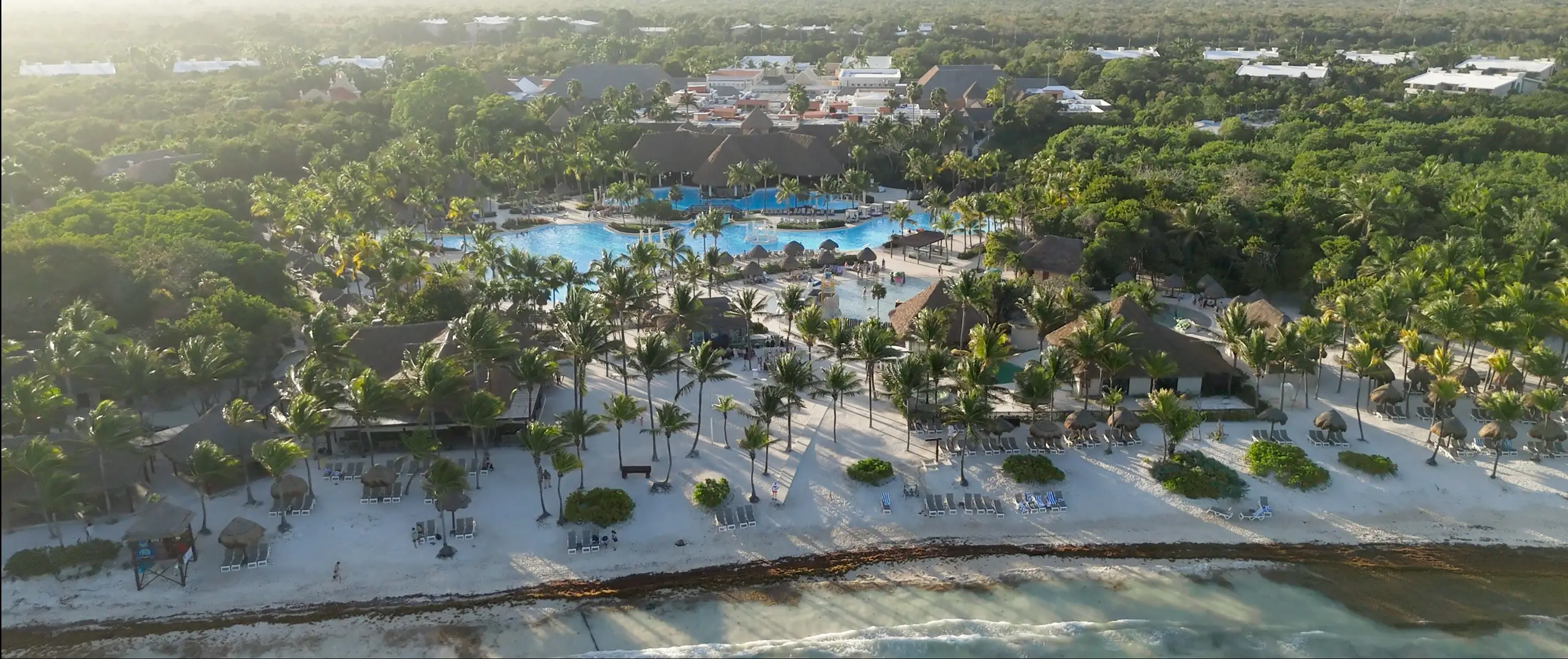
Aerial footage has become an expected part of the destination wedding film: the venue from above, the coastline, the couple on an empty beach. What almost nobody explains to couples is that drone footage at a wedding in Mexico sits at the intersection of four separate layers of rules, and a videographer who ignores any one of them is gambling with your wedding day. A confiscated drone or a fine is not a hypothetical. It is the predictable result of assuming that what works in one country works in another.
This article explains the four layers in plain language, and gives you the questions that separate videographers who operate seriously from those who improvise.
Layer one: Mexican federal law, and why a US certification means nothing here
The authority that regulates drones in Mexico is AFAC, the Agencia Federal de Aviación Civil. It is Mexico's equivalent of the FAA, and its rules govern every drone flight in Mexican airspace, including the one over your ceremony.
The single most misunderstood fact in this space: an FAA Part 107 certification, the standard credential for commercial drone pilots in the United States, has zero legal standing in Mexico. A US-certified pilot flying commercially in Mexico without Mexican authorization is flying illegally, full stop. This matters enormously for couples hiring videographers who fly in from the US or Canada: the credential they show you was issued for a different country's airspace.
Mexican regulation also restricts flights over gatherings of people without specific authorization, which describes almost every wedding ceremony ever held. Serious operators plan around this: aerials of the venue and landscape at times and positions that comply, rather than hovering over your seated guests.
Layer two: controlled airspace
Drone rules are not uniform across a region. Proximity to an airport creates controlled airspace with additional restrictions, and the Cancún hotel zone sits close enough to Cancún International Airport that flights there involve exactly this problem. The same logic applies near any airport along the corridor.
What this means practically: whether a drone can fly at your venue is a question about your venue's specific location, not about the region in general. Two properties twenty minutes apart can have completely different answers.
Layer three: protected zones
Mexico protects two kinds of territory that overlap heavily with wedding country. Archaeological zones fall under INAH, the national institute that administers heritage sites, and flying over or near sites like the Tulum ruins requires permits that are neither fast nor automatic. Natural protected areas, like the Sian Ka'an biosphere reserve south of Tulum, carry their own restrictions.
If your venue sits near ruins, inside a reserve, or along the stretches of coast adjacent to either, the aerial shot you saw on another couple's video may simply not be legal at your location. A videographer who knows the corridor knows where these lines run. One who doesn't will find out on your wedding day.
Layer four: the venue's own policy
Even where the law allows a flight, the property decides who flies on its grounds. Resort policies vary from open, to restricted to in-house teams only, to prohibited entirely. Some properties require drone arrangements to be confirmed weeks in advance. Private venues are generally more flexible, but the question still has to be asked, and the answer still has to be in writing.
This is the layer couples can actually verify themselves with one email: ask your venue directly what its drone policy is for outside videographers, and ask how far in advance approval must be requested.
What this means for your wedding film
None of this means you should give up on aerial footage. It means aerial footage is a conditional deliverable, not a default one, and any videographer who promises it unconditionally, before confirming your venue, your airspace, and the required authorizations, is telling you something about how they operate.
The honest version of the drone conversation sounds like this: aerials are planned per venue, confirmed in writing in advance, and always subordinate to the parts of the day that cannot be repeated. A drone shot can be scheduled. Your vows cannot. When wind, rules, or timing force a choice, the film is built from what matters, and no wedding film was ever great because of a drone shot alone.
The questions to ask any videographer about drones
Ask whether they hold Mexican authorization to fly commercially, not a US or Canadian one. The answer reveals immediately whether they understand where they are flying.
Ask whether they have confirmed the drone policy at your specific venue, in writing. "We fly everywhere" is not an answer. Venue-specific confirmation is.
Ask what happens to your film if the drone cannot fly that day. The right answer describes a film that stands entirely on its own, with aerials as a bonus. The wrong answer treats the drone as a structural part of the coverage.
Ask whether drone coverage is priced and scoped as its own item. Serious operators treat aerials as a defined add-on with its own conditions, because that is what the regulatory reality makes them. Vague inclusion usually means vague planning. This is exactly the kind of deliverable worth confirming in your contract, along with everything covered in what every couple should know before signing a wedding videography contract.
Closing thoughts
Mexico is not hostile to drones. It is simply a country with its own rules, layered across federal law, airspace, heritage, and property. Couples do not need to master those rules. They need to hire someone who already has, and the four questions above will tell you in one conversation whether you are talking to that person.
If your venue is in the Cancún, Playa del Carmen, or Tulum corridor, the specific considerations for filming there, drone access included, are covered in our guides to wedding videography in Cancún and Playa del Carmen and Tulum.
Frequently Asked Questions
Can a US-certified drone pilot legally fly at a wedding in Mexico?
Not on the US credential alone. FAA Part 107 certification has no legal standing in Mexico. Commercial drone operations in Mexican airspace fall under AFAC, Mexico's civil aviation authority, and require Mexican authorization. A videographer flying commercially on a foreign certification is operating illegally, regardless of experience.
Are drones allowed at weddings in Cancún and Tulum?
It depends on the exact location, not the region. The Cancún hotel zone sits in controlled airspace near the international airport, parts of the Tulum coast sit near INAH archaeological zones and the Sian Ka'an biosphere reserve, and every venue has its own drone policy on top of the law. The only reliable answer comes from confirming your specific venue, in writing, in advance.
Do wedding venues in Mexico allow outside videographers to fly drones?
Policies vary widely. Some venues allow outside drones with advance approval, some restrict flights to in-house teams, and some prohibit them entirely. Several properties require drone arrangements to be confirmed weeks before the event. Ask your venue directly for its written drone policy before assuming aerial footage is possible.
Should aerial footage be guaranteed in a wedding videography contract?
No, and a videographer who guarantees it unconditionally is overpromising. Drone coverage in Mexico depends on federal authorization, airspace, protected zones, venue policy, and weather on the day. The professional approach treats aerials as a defined, conditional add-on, planned per venue and confirmed in advance, with a film that stands on its own if the drone cannot fly.