
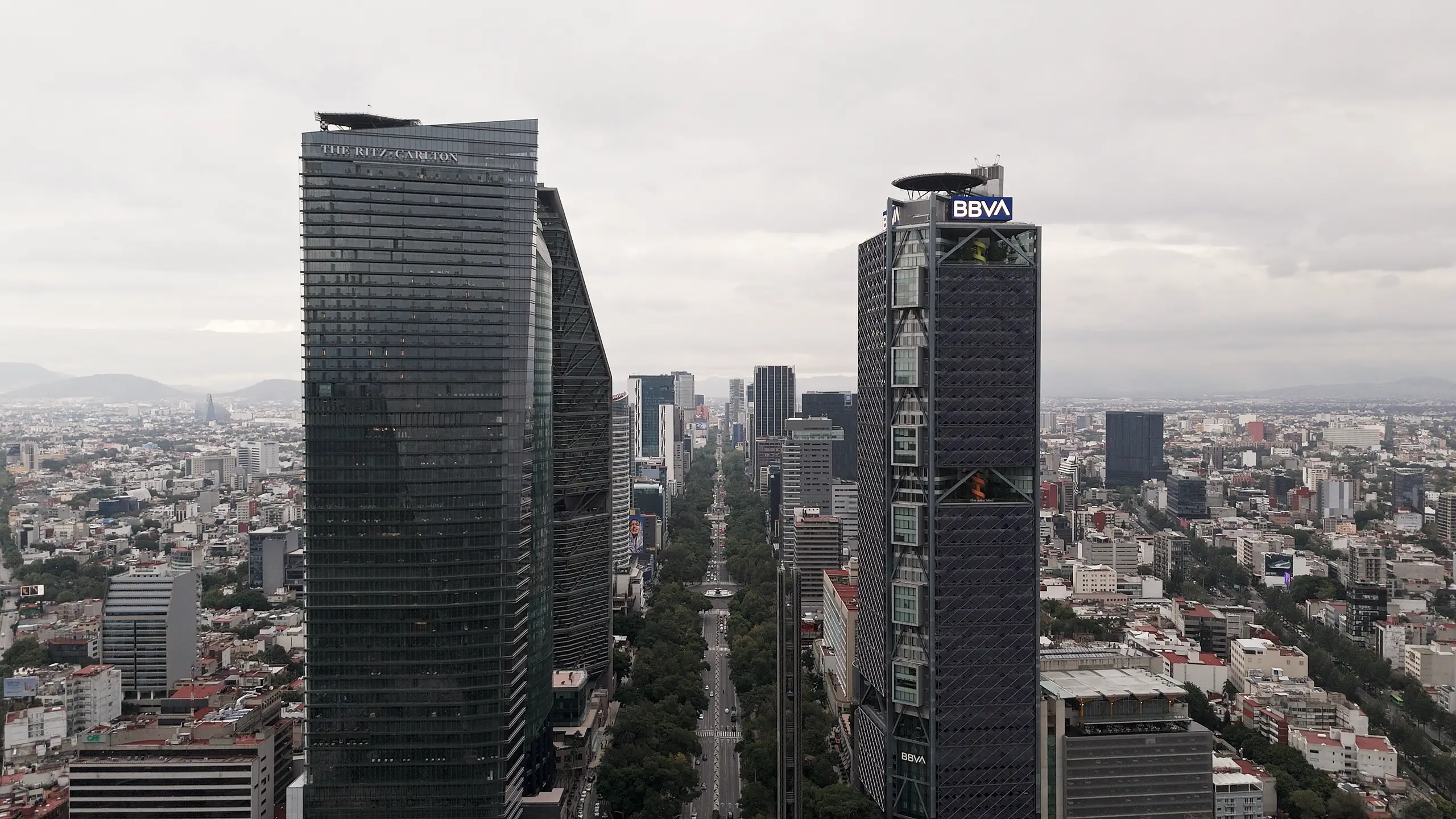
Wedding Videographer in Mexico City
For temples and colonial houses, there is nothing like Mexico City. The venues built inside those buildings have no real comparison anywhere in the country. They are majestic, and they are the reason a wedding here looks like nowhere else.
I'm Xavier Magaña, a documentary wedding filmmaker. I'm based in Cancún now, and I'm from Mexico City.
I grew up in the south of the city, near San Ángel, and lived there into my thirties. I went to a lot of weddings in that city, and before I moved into film, I photographed some of them. What I have not done is film a wedding there, and I'm not going to write this page as though I have.
I have been to weddings at Hacienda de los Morales, at San Ildefonso, at Las Vizcaínas, at San Hipólito, at the Casino Español, and at the Club de Banqueros. I know what those rooms do to light and where a person can actually stand in them.
A hacienda wedding, filmed for a Mexico City couple
María & Fernando — Hacienda Xtepen, Mérida, Yucatán
María and Fernando are from Mexico City. They married at Hacienda Xtepen, a seventeenth-century hacienda near Mérida, and I filmed all three days of it. Stone arcades, a ceremony in late light, a reception under the trees that ran into the night.
If your wedding is landing at Hacienda de los Morales, or anywhere with that same colonial weight, this is the closest read you will get on how I would film it. Watch it in full. I publish complete films rather than highlight reels, because ninety seconds of the best shots hides whether a filmmaker can hold a story together across a whole wedding, and a full film cannot hide it.
“From the very beginning, Xavier was professional, responsive, and genuinely great to work with. He created an environment where everything felt natural, never forced or staged, and captured the real essence of the day with remarkable attention to detail.”
What Mexico City asks of a wedding film
The traffic is what breaks timelines, and nobody puts it in writing. From the south of the city to the Centro on a Saturday afternoon, plan on an hour. From Polanco to the Centro, plan on forty minutes at minimum, which surprises people because on a map the two look adjacent. The distance is short. The secondary streets are what cost you. I grew up crossing this city and I still open Waze before every leg, because in Mexico City it genuinely works. A timeline built on optimistic drive times is the most common way a wedding day starts losing minutes it never gets back.
The clear season and the clean season are not the same season. Winter into spring gives you no rain and open skies, and it also gives you the haze that settles over the valley. Summer is the reverse: the air is far cleaner, and it rains almost every afternoon from four or five, through the summer and into part of the autumn. Most guides will tell you to marry in the dry season. That advice is right about rain and wrong about a wide shot of the city, and it is worth knowing which of the two you are optimizing for before you pick a date or a venue with a view.
The city sits at 2,240 meters. UV is stronger and midday contrast is harder than anywhere on the coast, and golden hour is short. This is mountain light, clean and direct when the air is clean. It rewards a schedule built around it and punishes one that ignores it.
A lot of Mexico City couples don't get married in Mexico City. Morelos, just south, is one of the most sought-after places for a capital wedding, and the state is full of haciendas. Hacienda Caltengo, north of the city, draws the same kind of booking. If that is where your wedding is landing, the logistics are a different conversation than an in-city wedding, and it is a conversation worth having early.
There is a noise ordinance, and receptions run into it. Mexico City permits 68 decibels between 6am and 10pm, and 65 decibels from 10pm to 6am, with PAOT as the enforcement body. Practically, this shapes when the loud part of the party happens. On my side it means recording vows, speeches, and ambient sound redundantly, so the audio carrying the film does not depend on how loud the room is allowed to be.
Filming in public space is free, and almost nobody mentions it. The Mexico City Film Commission allows filming on public property, plazas, gardens, sidewalks, at no cost, with notice at least twelve hours before a working day of filming. That is a documented, official process, which makes Mexico City unusually workable compared with historic centers where nothing is published. If a sequence in the street is part of what you want, it is a scheduling question, not a gamble.
Monuments and museums are a different regime, and that one costs money. Properties under INAH custody require a separate permit and fee when professional equipment is used, with figures cited up to around 10,905 pesos per day for INAH areas. San Ildefonso is exactly this case. It is the most under-disclosed cost in the region, and it belongs on a quote as its own line, disclosed before anyone signs.
Only the civil ceremony is legally binding. The religious or symbolic ceremony carries no legal weight in Mexico, which is why many couples split the two across different days or venues. That is two shoot blocks inside one wedding, each with its own load-in, light, and rules.
Venues and churches, and one thing worth knowing about each
Named here because they come up constantly in planning, not because I have filmed at them. Each note is a logistical fact, not a review.
Hacienda de los Morales, Polanco. A sixteenth-century hacienda with multiple ballrooms, scaling to around a thousand guests. Its vendor policy is split in a way that is easy to misread: catering is exclusively in-house, while outside AV, entertainment, and transport are allowed. Video sits on the open side of that line.
Antiguo Colegio de San Ildefonso, Centro Histórico. A former Jesuit college with a grand courtyard, and one of the most photographed interiors in the city. Under INAH custody, so professional equipment triggers a separate permit and fee. Budget it explicitly.
Colegio de las Vizcaínas, Centro Histórico. Eighteenth-century colonial building with an interior courtyard, in the dense part of the Centro where load-in and parking are the real constraint, not the room.
Casino Español and Club de Banqueros, Centro. Historic society buildings with formal salons, the kind of interior where the ceiling is part of the shot and the available light is entirely artificial.
Casonas in Coyoacán and San Ángel, gardens in the Pedregal. The south of the city runs on converted colonial houses and garden restaurants rather than hotel ballrooms. Typically friendlier to an outside vendor team than a hotel is.
Jardín Mayita, Constituyentes. A garden venue on the western side of the city, close enough to Chapultepec that it draws couples who want green without leaving town. Worth pairing with a realistic drive time from wherever the ceremony happens, because Constituyentes at the wrong hour is its own problem.
Churches. Many of the convents in the Centro have their own chapel, which lets ceremony and reception happen inside the same walls. Near the Centro, La Profesa sits at Isabel la Católica and Madero. In Coyoacán, San Juan Bautista anchors the main square. In Santa Fe, the Parroquia de San Josemaría Escrivá is a modern church used constantly for weddings, and a completely different lighting problem than a colonial nave. Camera positions and flash rules are set by each parish and are not published anywhere; they get confirmed with the parish before the booking, not discovered in the doorway.
Facts for planners
One person, start to finish
I film a limited number of weddings a year, so the person you meet is the person who shows up and the person who edits.
No direction, no delays
I don't direct, pose, or recreate. Nothing is asked to happen twice, and the timeline doesn't lose a minute to video.
Handled in advance
I coordinate with the photographer rather than competing for position, and permits and access, including INAH and city film notices, are sorted before the day, not at the gate.
How I work
On the day, my only job is to watch. The film is built afterward in the edit, carried by the real audio of the wedding, the vows, the speeches, the sound of the room, with music and pacing chosen for that specific day rather than pulled from a template.
I'm based in Cancún and travel from there, to the city I grew up in. Travel and availability are settled in the conversation, before anything is booked.
If what you are picturing is smaller and more colorful, a town rather than a capital, that is San Miguel de Allende, and there is a page for it.
Questions couples ask
Have you filmed a wedding in Mexico City?
Not yet, and I would rather say that plainly. I'm from Mexico City, I grew up in the south of it, I have been to weddings at Hacienda de los Morales, San Ildefonso, Las Vizcaínas, the Casino Español, and the Club de Banqueros, and I photographed weddings in that city before I moved into film. The couple in the film on this page, María and Fernando, are from Mexico City. What I have not done is film a wedding inside the city, and no page of mine is going to imply otherwise.
How much time should the timeline allow for crossing the city?
More than people expect. South of the city to the Centro on a Saturday afternoon, plan on an hour. Polanco to the Centro, forty minutes at minimum, even though the two look adjacent on a map, because the route drops you into secondary streets. Waze is genuinely reliable in Mexico City and I use it on every leg. Most timeline problems in this city are drive-time problems.
When is the best time of year for a wedding in Mexico City?
It depends on what you are protecting. Winter and spring are dry and open, and also hazy over the valley. Summer has much cleaner air and rain almost every afternoon from four or five o'clock. If you want a clean wide shot of the city, the calendar advice most people give you is backwards. If you want to keep rain out of the reception, it is right.
Do you need a permit to film a wedding in Mexico City?
It depends where. Filming on public property, plazas, gardens, sidewalks, is free through the Mexico City Film Commission with notice at least twelve hours before a working day. Properties under INAH custody, which includes museums and several historic buildings such as San Ildefonso, require a separate permit and fee for professional equipment, cited at up to around 10,905 pesos per day. I handle both in advance and disclose the INAH cost as its own line.
Can you fly a drone in Mexico City?
Rarely where couples imagine. Drones are regulated nationally by AFAC, with registration required between 250 grams and 2 kilos, visual line of sight, and a five-nautical-mile buffer from aerodromes, which covers much of the valley. Historic and archaeological sites are prohibited or require prior authorization. I plan a Mexico City wedding assuming no drone and treat it as a bonus if a venue clears it.
Planning a Wedding in Mexico City?
Documentary wedding films for haciendas, historic courtyards, and private houses across Mexico City. Starting at $7,000 USD. Custom collections are built around coverage, story depth, and creative scope.
Want to understand how the investment is structured before reaching out? Full details here. → Wedding film investment and coverage options for destination weddings in Cancún and the Riviera Maya. Starting at $7,000 USD.