
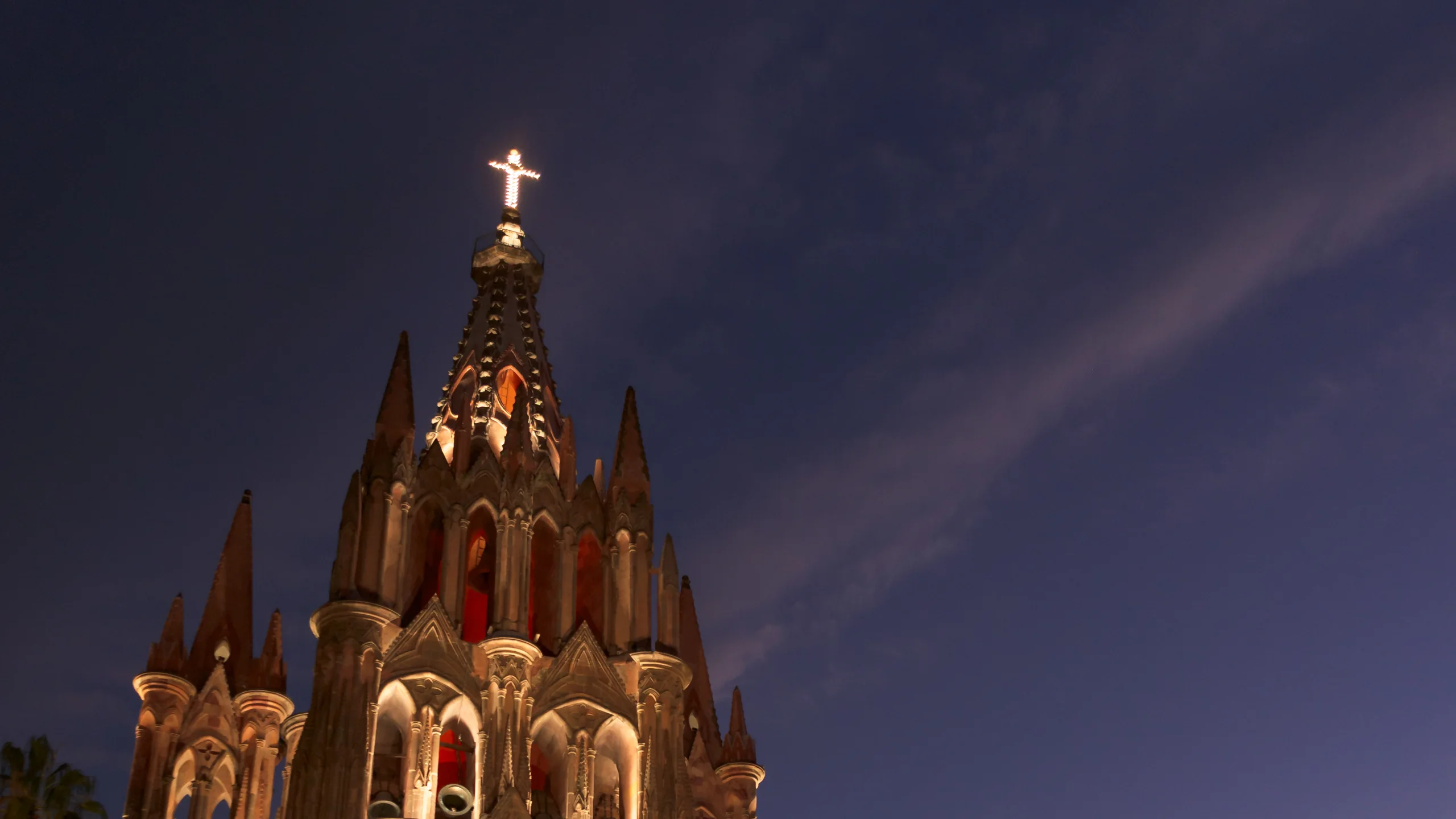
Wedding Videographer in San Miguel de Allende
If what you want is something smaller, in a town that feels alive and colorful, with sunsets worth building the day around, San Miguel de Allende is one of the best choices in Mexico.
It is a wedding town built out of stone and ochre. The ceremony often happens in a parish church that has stood for centuries, and the celebration spills out into cobblestone streets behind a brass band and a pair of giant papier-mâché puppets. It is one of the few places in Mexico where the walk between two venues is itself a sequence worth filming.
It also punishes anyone who arrives with a beach-wedding template.
I'm Xavier Magaña, a documentary wedding filmmaker based in Cancún, and I travel from there for weddings across Mexico.
I have not filmed a wedding in San Miguel de Allende, and I'm not going to write this page as though I have. I have been four times, and I have watched a wedding callejoneada move through those streets at dusk. What I can show you is the wedding that transfers most directly: three days at a seventeenth-century hacienda in Yucatán, filmed end to end.
A hacienda wedding, start to finish
María & Fernando — Hacienda Xtepen, Mérida, Yucatán
María and Fer's wedding was a three-day celebration at Hacienda Xtepen, near Mérida. Stone arcades, a ceremony in late light, a reception that ran into the night under the trees. It is the same colonial vocabulary you find in the Bajío, and the day is built the same way: slow morning, ceremony at the hour the light turns, party as the real ending.
You can watch the whole thing above. I publish complete films rather than highlight reels, because ninety seconds of the best shots hides whether a filmmaker can hold a story together across an entire wedding, and a full film cannot hide it.
What San Miguel asks of a wedding film
The light sits at altitude. San Miguel is roughly 1,800 to 2,000 meters up. This is central plateau light: mountain light, clean and direct, under skies that stay clear most of the year outside the rainy months. It also means harsher contrast at midday, stronger UV, and a golden hour that arrives and leaves faster than it does at sea level. On the coast a filmmaker can drift into the good light. Here you plan the ceremony around it or you lose it, and the reward for planning it right is the thing everyone remembers about this town, which is what the sun does on the way down. In the rainy season, June through September, the pattern is consistent: clear mornings, rain in the late afternoon for thirty to sixty minutes, and skies that clear again before dinner.
Most weddings here are two ceremonies, not one. Only the civil ceremony carries legal weight in Mexico. The religious or symbolic ceremony that follows is the one most couples picture when they imagine the day. Couples frequently split the two across different locations or different days, which means two separate shoot blocks inside one wedding, each with its own load-in, its own light, and its own rules.
The callejoneada is the most cinematic thing in the region, and I have watched one. It starts in the afternoon. The band leads, and everyone walks behind it, drinking and carrying on, moving at the pace of a crowd rather than a schedule. What makes it a filming problem rather than just a pretty one is the light: it begins in daylight and ends with artificial light dominating, because the sun goes down while the procession is still walking. That transition is the sequence. You either plan the exposure through it or you lose the second half of it. No coastal venue in Mexico offers anything equivalent.
It is also the part of the day with the least documentation: no municipal portal publishes the permit fee, the application, or the lead time. Any filmmaker who promises you a guaranteed procession has not checked. It is coordinated through your planner well in advance, and I would rather tell you that now than on the wedding day.
The historic center is protected, and cameras are part of what is regulated. Drone use in Mexico is governed nationally by AFAC: aircraft between 250 grams and 2 kilos must be registered, stay within visual line of sight, and keep at least five nautical miles from any aerodrome. Flying over historic and archaeological sites is prohibited or requires prior authorization. Inside San Miguel's protected core, treat a drone as a permit question, never as an assumption. Venues on the edge of town are materially simpler in this respect.
Church rules are the least published link in the chain. The parish does not publish its photography and video rules in any accessible form. Camera positions, flash, and where a filmmaker may stand during the Mass all have to be confirmed with the parish directly, before the booking. I do that as part of the preparation rather than discovering it in the doorway on the day.
Venues, and one thing worth knowing about each
Named here because they come up constantly in planning, not because I have filmed at them. Each note is a logistical fact, not a review.
Casa Hyder. A private eleven-bedroom villa in the historic center, rented as a full property buyout. Outside-vendor friendly by default, which is the opposite of the hotel-brand model and the reason it appears in so many independent photographers' portfolios.
Instituto Allende. A historic art school with a colonial courtyard and a terrace that holds a large reception. It runs on a rental-only model, so the couple brings their own vendor team rather than choosing from an in-house list.
Belmond Casa de Sierra Nevada. Six restored mansions spread across the historic center rather than one building. The logistical consequence is real: the wedding moves between separate properties on cobblestone streets, which changes crew routing and how gear gets from one space to the next.
Rosewood San Miguel de Allende. Garden ceremony space that scales from intimate to a few hundred. Catering is exclusively in-house, while outside photography and video are typically allowed with a vendor fee. Where a hotel charges that fee, the industry-standard lever is a room-block waiver: crew nights on property in exchange for dropping the outside-vendor fee.
Hacienda San José Lavista. A hacienda and winery on the Nuevo Libramiento, with a chapel and large gardens. The detail that matters for video: it sits outside the protected historic center, so aerial and equipment restrictions are considerably less complicated than at a venue inside the core.
Hacienda Los Picachos. A vineyard hacienda on the outskirts, built for multi-day celebrations. Also outside the protected core, and suited to the welcome-dinner-plus-wedding structure that multi-day San Miguel weddings tend to take.
Facts for planners
One person, start to finish
I film a limited number of weddings a year, so the person you meet is the person who shows up and the person who edits.
No direction, no delays
I don't direct, pose, or recreate. Nothing is asked to happen twice, and the timeline doesn't lose a minute to video.
Handled in advance
I coordinate with the photographer rather than competing for position, operate the venue in Spanish, and sort permits and access before the day, not at the gate.
How I work, and how travel works
On the day, my only job is to watch. The film is built afterward in the edit, carried by the real audio of the wedding, the vows, the speeches, the sound of the room, with music and pacing chosen for that specific day rather than pulled from a template.
I'm based in Cancún and travel from there. Couples flying in from abroad generally route through León or Querétaro and drive in; from Mexico City it is a straightforward drive, which is how I have always arrived. For a wedding here I come in early enough to see the venue in its real light before the wedding day, and to confirm anything the church or the municipality needs confirmed. Travel and availability are settled in the conversation, before anything is booked.
If what you are picturing is grander and more formal, colonial architecture on a monumental scale, that is Mexico City rather than San Miguel, and there is a page for it.
Questions couples ask
Have you filmed a wedding in San Miguel de Allende?
No. I have been four times and I have watched a wedding callejoneada move through those streets, but I have not filmed a wedding there and I'm not going to imply otherwise. What I publish instead are complete films from the weddings I have filmed, including the three-day hacienda celebration in Yucatán embedded on this page. Colonial stone, a late-light ceremony, and a reception that runs into the night are the same problem to solve in the Bajío as in Yucatán.
Do you travel from Cancún for a wedding in San Miguel?
Yes. Travel from Cancún is part of how the work is planned, and I arrive early enough to see the venue in its real light and to confirm church and municipal requirements before the wedding day. Travel and availability are settled in the conversation, before anything is booked.
Can you film the callejoneada?
Yes, and having watched one I know the real difficulty is light rather than movement. It starts in the afternoon and finishes with artificial light taking over as the sun drops, while the crowd keeps walking. Planning the exposure through that transition is the whole job. What I won't do is guarantee the permit. No municipal source publishes the fee schedule or lead time, so it is coordinated through your planner well in advance, and the film is planned so the day still works if the procession shifts.
Does altitude really change the film?
It changes the schedule, which changes the film. San Miguel sits around 1,800 to 2,000 meters. Contrast at midday is harsher, UV is stronger, and golden hour is shorter than at sea level. In the rainy season the rain tends to fall between four and six in the afternoon and clear before dinner. Planning the ceremony around that window is the difference between light you can use and light you fight.
What about drone footage in the historic center?
Treat it as a permit question rather than a given. Drones in Mexico are regulated nationally by AFAC, with registration required between 250 grams and 2 kilos, visual line of sight, and a five-nautical-mile buffer from aerodromes. Historic and archaeological sites are prohibited or require prior authorization. Venues outside the protected core, like the haciendas on the edge of town, are considerably simpler in this respect.
Planning a Wedding in San Miguel de Allende?
Documentary wedding films for haciendas, private villas, and historic venues in San Miguel de Allende and the Bajío. Starting at $7,000 USD. Custom collections are built around coverage, story depth, and creative scope.
Want to understand how the investment is structured before reaching out? Full details here. → Wedding film investment and coverage options for destination weddings in Cancún and the Riviera Maya. Starting at $7,000 USD.