
Wedding Videographer in Playa del Carmen and Tulum
Documentary wedding films with cinematic storytelling for destination weddings along the Riviera Maya corridor, from Playa del Carmen to Tulum.
Real storytelling. Films that feel like true cinema.
Based in Cancún, filming
across the Riviera Maya and beyond.
I'm a wedding filmmaker based in Cancún, Mexico, with a Master's in Digital Photography from the School of Visual Arts in New York. I specialize in documentary wedding films with cinematic storytelling for couples getting married along the Riviera Maya corridor between Playa del Carmen and Tulum, from cenote ceremonies and jungle venues to the resort and boutique properties that line the coast south of Cancún.
My approach is built on observation, not direction. I don't position people or recreate moments. I follow what's unfolding, the quiet exchange before the ceremony, the way the room shifts when the speeches start, the emotional details that are gone before most people notice them. That's what ends up in the film.
I film a limited number of weddings (8-10) each year. Not for the aesthetic of scarcity but because this kind of work requires full attention, and full attention doesn't scale.
Filming Destination Weddings Between Playa del Carmen and Tulum
The corridor between Playa del Carmen and Tulum is its own distinct geography within the Riviera Maya. The federal highway runs roughly parallel to the coast for about an hour of driving, and along that stretch the wedding landscape splits into three different worlds: the all-inclusive resort belt north of Tulum, the boutique beach road that runs along Tulum's coast, and the cenote corridor that cuts inland through the jungle between them. Each one has its own rhythm, its own light, its own logistics.
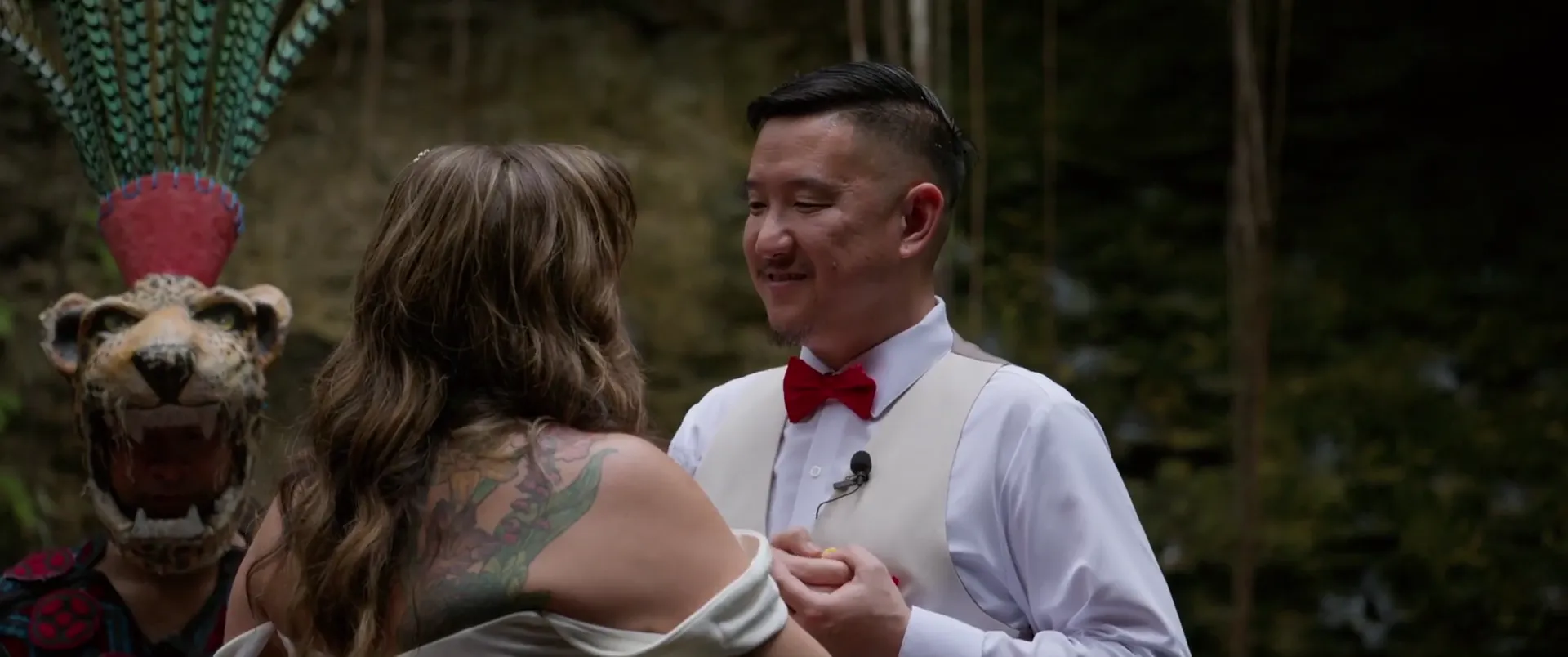
I've filmed Maura and Jason's wedding at Cenote Hats'uts, where the underwater light moves in a way that doesn't exist anywhere else on the corridor, and I'm currently finishing a film shot at Grand Palladium Colonial Resort and Spa, one of the larger resort properties in this stretch. Each location works differently. A cenote ceremony is governed by light, water levels, and acoustics that change throughout the day. A resort wedding has its own internal logic of timelines, vendor coordination, and ceremony spaces designed for repeatable production.
That local knowledge matters more than most couples realize when they're planning from New York or Toronto or London. Knowing how the jungle humidity affects equipment after 4 PM, where the afternoon light falls at a beachfront property in Tulum, which entrance the resort security will ask you to use, which cenotes have the best light at 11 AM versus 2 PM. These are not things you learn from a scouting visit. They come from being here.
Outside Vendor Fees at Cancún Resorts: What Couples Need to Know
$300–$1,500
Typical outside vendor fee range per vendor at Cancún resorts
Ask before signing
Confirm the vendor fee policy in writing before you sign the resort contract
AFAC certified
Drone permits confirmed with each venue in advance
Most all-inclusive resorts along the Riviera Maya charge an outside vendor fee whenever you bring in a videographer who isn't on their internal list. The fee typically ranges from $300 to $1,500 per vendor depending on the property, and it's almost never mentioned upfront. Most couples discover it after they've already signed the resort wedding contract, which is exactly the wrong moment to find out.
The single most useful thing you can do before signing anything with your resort is ask their wedding coordinator one specific question in writing: what is your outside vendor fee for a videographer, and is there a waiver policy? Some resorts will reduce or eliminate the fee if the vendor stays on property as part of the room block. Not every resort offers this, but knowing to ask before you sign gives you leverage you won't have afterward.
Resort wedding coordinators are also evaluated on in-house vendor bookings, which means their guidance on outside vendors isn't always neutral. Understanding that dynamic helps couples interpret their coordinator's recommendations with the right amount of skepticism.
On the question of drones: aerial footage requires a separate permit from AFAC, Mexico's civil aviation authority. An FAA Part 107 certification has no legal standing in Mexico. Drone access at each venue is confirmed directly with the property in advance, since policies vary by property and some resorts restrict outside vendors from flying regardless of permits. Tulum's beach road has its own additional considerations because of proximity to certain protected areas.
I go through all of this with couples and their planners well before the wedding date. Vendor access, fee structure, drone permissions, resort coordination, these conversations happen early so none of it becomes a problem on the day itself.
Documentary Wedding Films That Feel Like True Cinema:
What That Actually Means
Most wedding videos follow the same structure regardless of who makes them: getting ready, ceremony, first dance, speeches, cut to music. A documentary film built around real storytelling works differently. Nothing is directed or recreated. The camera follows what is actually happening, and the edit is built around the real narrative of the day rather than a predetermined template. The result is a film that feels specific to you because it was made from observing you, not from a production checklist. Documentary in how it's captured, cinematic in how it's told.
Observation over direction
No posing, no recreating moments, no asking people to look at the camera. The film is built from what actually happened.
Editorial judgment
Every wedding produces hours of footage. What ends up in the film is a decision, not a highlight reel. Each edit is built around the specific story of that day.
Sound as narrative
Vows, speeches, the ambient sound of the ceremony space. Immersive audio design is as much a part of the film as the image.
A limited number of weddings per year
Between 8 and 10 weddings a year. Not as a marketing device. Because this level of attention is not compatible with volume.
Each film includes a trailer of sixty to ninety seconds and a documentary film of fifteen to twenty-five minutes, delivered within twelve weeks of the wedding date. Photography is also available for couples looking for a cohesive photo and film experience built around the same documentary approach.
What couples say
"Hiring Xavier for our wedding cinematography was the best decision we made. His cinematography is so beautiful, everyone we show our video to says they've never seen anything like it. He truly captured all the emotions and love of our special day. We will be forever thankful."
"From the very beginning, Xavier was professional, responsive, and always with a great attitude. He never forced moments or made anything feel staged. He truly captured the essence of our day, the real emotions, the energy, the small details you don't even realize are happening in the moment. The final product exceeded our expectations. The editing is beautifully done and the video genuinely brings us back to that day every time we watch it."
"Xavier's work was professional and attentive. Our wedding videos were a hit, everyone laughed and cried because he captured all of the memorable moments. Amazing quality. Our wedding video will always be cherished."
 Featured on Love Stories TV
Wedding Venues Between Playa del Carmen and Tulum
The stretch of coast between Playa del Carmen and Tulum holds some of the most distinctive wedding venues in Mexico, and the choice of venue shapes the film as much as anything else. On the resort side, properties like Grand Palladium Colonial Riviera Maya, Dreams Tulum, and Secrets Tulum run full wedding programs with dedicated coordinators, established timelines, and outside vendor policies worth understanding before you sign anything. These resorts handle volume well, but the same structure that makes them efficient also makes them visually similar from one wedding to the next, which is why the documentary approach matters more in those settings, not less.
The Tulum beach road operates by a completely different logic. Luxury boutique properties like Casa Malca, La Valise Tulum, Papaya Playa Project, Sanará, and Akiin Beach Club don't run resort wedding programs. They host smaller, more design-driven weddings where the venue itself is part of the aesthetic. Each one has its own light, its own access constraints, and its own rules about what's allowed during a ceremony. Beach road venues also share a general logistical reality worth knowing in advance: traffic, ceremony curfews tied to environmental regulations, and limited backup options if weather shifts.
Then there are the cenotes. Cenote Hats'uts and the broader cenote corridor between Playa and Tulum offer something no resort can replicate: ceremony spaces formed over thousands of years, with light and acoustics that are unlike anything above ground. Filming a cenote wedding requires understanding how the light moves through the water column at different times of day, where to position for the ceremony without disrupting the space, and how to capture audio that sounds clean despite the acoustic peculiarities of an underground space. It's also worth noting that 16 Tulum and similar inland venues blend the jungle setting with built architecture in ways that can be filmed beautifully if you know how the light works in those spaces.
Wherever the wedding is, the location shapes the film. That is either a challenge or an advantage depending on how well the filmmaker knows the place.
Venues in the Riviera Maya
Filming a Wedding at Cenote Hats'uts → A complete wedding film shot at Cenote Hats'uts in the Riviera Maya, including a traditional Maya ceremony, plus a filmmaker's guide to light, sound, and logistics. Filming a Wedding at Grand Palladium Colonial → A complete wedding film shot at Grand Palladium Colonial in the Riviera Maya, plus a filmmaker's real experience with the resort's vendor policy, coordinators, and two ceremonies in one day. Rosewood Mayakoba: A Wedding Filmmaker's Field Notes → A filmmaker's field notes on Rosewood Mayakoba: its absolute drone prohibition, the Aquí Me Quedo ceremony space, and how I would approach filming a wedding at this Mayakoba property. Hotel Esencia: A Wedding Filmmaker's Field Notes → A filmmaker's field notes on Hotel Esencia: its Forbes Five-Star and Michelin Three Keys distinction, the Esencia Mansion ceremony space, and how I would approach filming a wedding on this private Xpu-Ha estate. Banyan Tree Mayakoba: A Wedding Filmmaker's Field Notes → A filmmaker's field notes on Banyan Tree Mayakoba: its seven named venues from The Shack to MK Blue, vendor policy, and how I would approach filming a wedding at this Mayakoba pool-villa resort. Dreams Riviera Cancun: A Wedding Filmmaker's Field Notes → A filmmaker's field notes on Dreams Riviera Cancun: its exact $250-per-person outside vendor fee, eleven named wedding spaces, and how I would approach filming a wedding at this Puerto Morelos all-inclusive.Frequently asked questions
Do resorts in Playa del Carmen and Tulum charge outside vendor fees for videographers?
Most all-inclusive resorts in Most all-inclusive resorts along the Riviera Maya, including properties around Playa del Carmen and Tulum, charge an outside vendor fee for any videographer not on their internal approved list. The fee typically ranges from $300 to $1,500 per vendor depending on the property. Some resorts offer alternatives, such as waiving the fee if the vendor stays on property as part of the couple's room block. The most important thing to know is that this fee is rarely mentioned upfront. Confirming the policy in writing before signing the resort wedding contract is the only way to avoid surprises later.
Can you film at boutique venues along the Tulum beach road?
Yes. Boutique properties along the Tulum beach road operate without the resort wedding program structure, which means vendor access is generally less restrictive but logistics are different. Each venue has its own rules about ceremony placement, music curfews, and equipment access. I confirm specifics with each venue directly during the planning phase so there are no surprises on the day. For couples planning a wedding at Casa Malca, La Valise Tulum, Papaya Playa Project, Sanará, Akiin Beach Club, or similar boutique properties, the production approach is adapted to the scale and rhythm of those spaces.
Have you filmed cenote weddings before?
Yes. I filmed Maura and Jason's wedding at Cenote Hats'uts, in the cenote corridor between Playa del Carmen and Tulum. Cenote weddings have specific requirements: the light shifts dramatically over the course of the ceremony, the acoustics behave differently than above ground, and movement around the ceremony space has to be carefully planned to avoid disrupting the moment. These conditions are part of why a cenote wedding produces such distinctive footage when it's filmed by someone who knows the environment.
What technical specs do you film in?
All wedding films are captured in 4K, 12 bit RAW, with cinema-grade lenses and dual recorder audio. The footage is hand-graded in post without LUTs, which is why the color in the final film looks specific to the day rather than processed through a preset. Drone footage, when permitted by the venue, is captured at the same resolution and integrated into the documentary edit rather than treated as separate b-roll.
Can you fly a drone at my Playa del Carmen or Tulum venue?
Drone operations in Mexico require certification from AFAC, Mexico's civil aviation authority. An FAA Part 107 certification has no legal standing in Mexico. Drone access at each venue is confirmed directly with the property well in advance of the wedding date. Policies vary by property. Some resorts restrict outside vendors from flying regardless of permits, and certain areas along the Tulum coast have additional restrictions due to proximity to protected zones. Drone access is never assumed and always confirmed in writing before the wedding day.
Drone rules for weddings in Mexico → US drone certifications have no legal standing in Mexico, and airspace, archaeological zones, and venue policies each add their own layer of rules. What couples should know before assuming their wedding will have aerial footage.Do you work with wedding planners?
Yes, and for destination weddings it makes a significant difference. A planner who knows the venue, the timeline, and the vendor team removes most of the logistical friction that can affect filming. I'm used to coordinating with planners and venue teams across the Cancún and Riviera Maya corridor, adapting to timelines as the day evolves without adding unnecessary complexity to their operation. If you don't have a planner yet, I'm happy to share who I know in the area.
If you're a planner looking for more details on how I work within your team, there's a page built specifically for that. → Wedding filmmaker based in Cancún who integrates cleanly into your workflow. No disruptions, no delays, no additional variables to manage. Available across Riviera Maya and Yucatán.Are you based in Playa del Carmen or Tulum?
I'm based in Cancún, which is roughly an hour's drive from Playa del Carmen and about an hour and forty minutes from Tulum. For weddings along this corridor, I typically travel the morning of preparation or the day before, depending on the schedule. Travel within the Riviera Maya is included in standard collections. I also film weddings across Mexico and internationally when couples are getting married elsewhere.
How far in advance should I book a wedding videographer for Tulum or Playa del Carmen?
For most wedding dates, six to eight months in advance is a reasonable minimum. December through April is peak season in the Caribbean, and those dates tend to fill earlier, particularly for Tulum beach road venues where weekend availability is finite. Since I film a limited number of weddings per year, availability is finite regardless of the time of year. If your date is more than a year out, it's still worth reaching out early to confirm availability and start the conversation before the planning gets more complex.
How it Works
Check availability
Receive pricing & custom collections
A conversation to
make sure we're a good fit
Secure your date
Planning a Destination Wedding in Playa del Carmen or Tulum?
Documentary wedding films for destination weddings along the Riviera Maya, from Playa del Carmen to Tulum and beyond. Starting at $7,000 USD. Custom collections are built around coverage, story depth, and creative scope.
Want to understand how the investment is structured before reaching out? Full details here. → Wedding film investment and coverage options for destination weddings in Cancún and the Riviera Maya. Starting at $7,000 USD.