
Wedding Videographer in Oaxaca
I would choose Oaxaca for the food, and because it carries more cultural weight than almost anywhere else you could get married in Mexico. San Miguel de Allende is a town, and a beautiful one. Oaxaca is a city, and one of the most culturally important in the country.
I'm Xavier Magaña, a documentary wedding filmmaker based in Cancún, and I travel from there for weddings across Mexico.
I have been to Oaxaca three or four times, always on my own time. The last time I went, it was for a wedding: the ceremony was at Santo Domingo and the reception was in the Jardín Etnobotánico, and it ran past midnight. There was a calenda that night too. I know the historic center well, and Monte Albán, and a couple of the other archaeological sites.
What I have not done is film a wedding in Oaxaca, and I am not going to write this page as though I have.
A colonial wedding, filmed end to end
María & Fernando — Hacienda Xtepen, Mérida, Yucatán
María and Fernando married at Hacienda Xtepen, a seventeenth-century hacienda near Mérida, and I filmed all three days of it. Stone arcades, a ceremony in late light, a reception under the trees that ran into the night.
It was filmed in Yucatán, not in Oaxaca. It is here because the problem is the same one: colonial stone, a ceremony timed to the light, and a celebration that outlasts the daylight. Watch it in full. I publish complete films rather than highlight reels, because ninety seconds of the best shots hides whether a filmmaker can hold a story together across a whole wedding, and a full film cannot hide it.
What Oaxaca asks of a wedding film
The Jardín Etnobotánico is not what it was, and this is the thing to get right. I was at a wedding there in 2013 where the reception ran past midnight. That is not what the garden is today. It is now documented as a ceremony-only site: no reception, no catering, no amplified music at any point, no DJ, no banda, no mariachi, and a ceremony window measured in about an hour including setup and departure. It is a protected cultural site and it requires a state permit through a process that is described as rigorous.
If your inspiration folder has photographs of a party in that garden, they are probably old, and mine would be too. Plan on a second venue for the reception, and confirm the current rules directly rather than from images. This is the single most common way a Oaxaca timeline gets built on something that is no longer true.
The calenda I saw was at night, and that is a different film than San Miguel's. In San Miguel the callejoneada starts in the afternoon and the whole sequence is about the light dropping while the crowd keeps walking. The Oaxaca calenda I watched ran after dark, lit entirely by whatever the street had. Mojigangas, a brass band, dancers in regional dress. That is not a lesser sequence, it is a different one, and it is exposed and planned differently. I would ask what time yours is scheduled before assuming either. The photograph below is mine, taken that night as a guest.
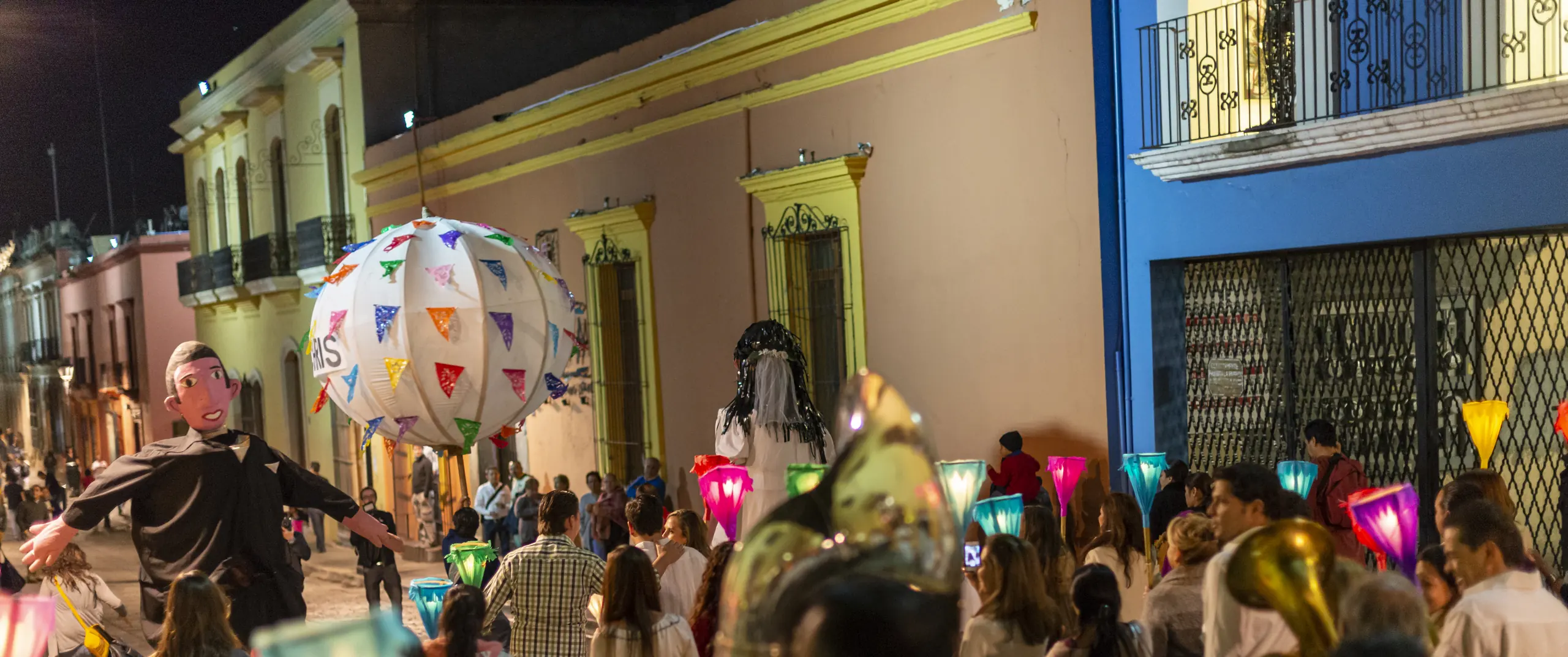
Nobody publishes what the calenda permit costs or how long it takes. No municipal source documents the fee schedule, the application or the lead time, in Oaxaca or in San Miguel. Any filmmaker who guarantees you a procession has not checked. It gets coordinated through your planner well in advance, and the film gets planned so the day still works if it moves.
Most weddings here are two ceremonies, not one. Only the civil ceremony carries legal weight in Mexico. The religious or symbolic ceremony that follows is the one most couples picture. Couples frequently split the two across locations or days, which means two separate shoot blocks inside one wedding, each with its own load-in, light and rules. In Oaxaca that pattern compounds with the garden problem above: a ceremony-only site plus a separate reception venue can turn one wedding into three locations in a day.
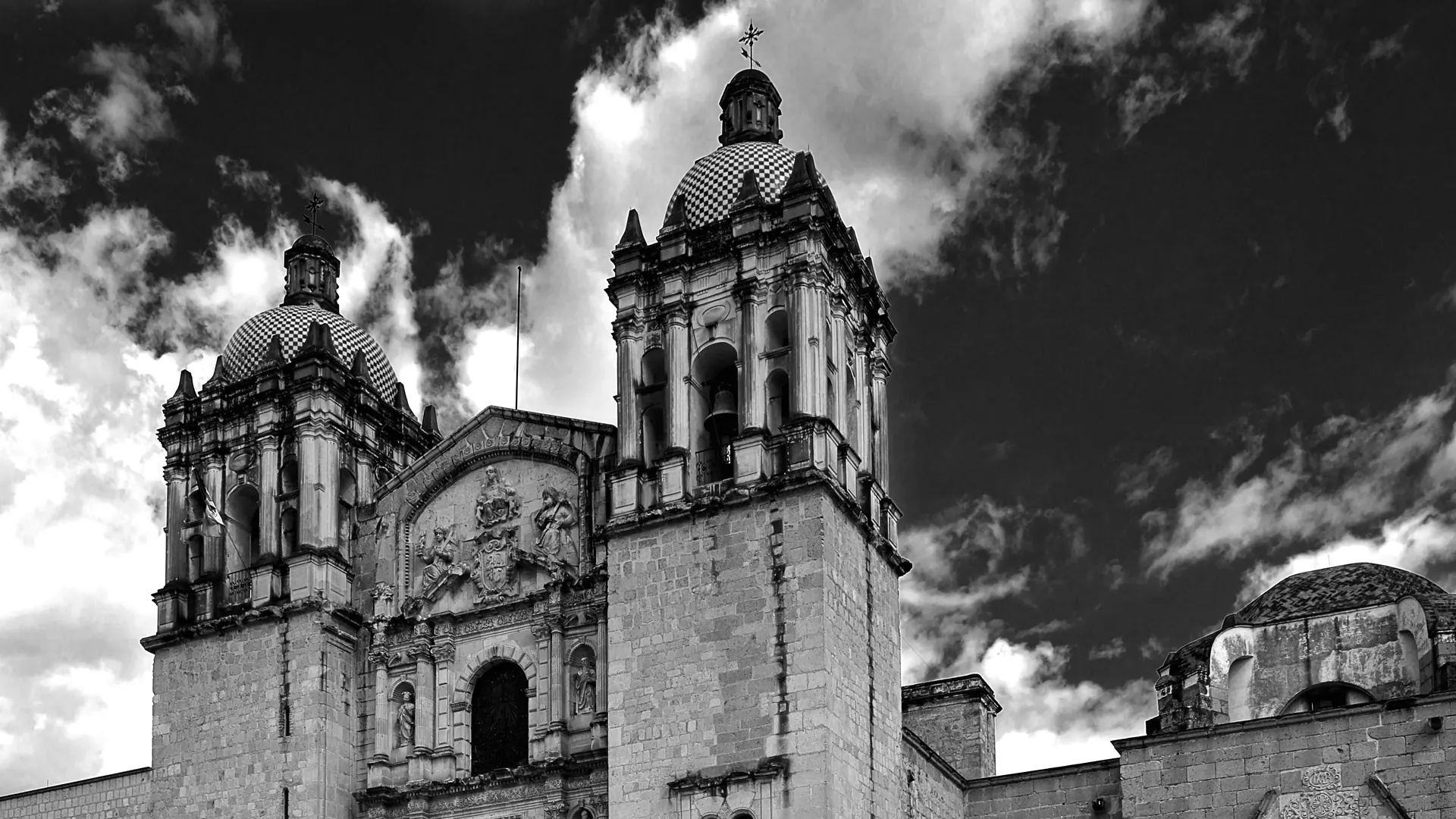
Santo Domingo is the room everyone pictures, and its camera rules are not published anywhere. The Dominican church in the center is the flagship ceremony site in the city and I have sat in it. Where a filmmaker may stand, whether flash is allowed, and what happens during the Mass are set by the parish, and no official source publishes them. That gets confirmed with the parish before the booking, not discovered in the doorway. A Catholic ceremony there also carries the usual paperwork: baptism, communion and confirmation certificates, the pláticas, and written approval from the pastor.
Oaxaca sits at about 1,550 meters, lower than San Miguel and much lower than Mexico City. The light is strong and clean for most of the year, with something like three hundred sunny days cited for the city. The dry season runs November to May. From June to October the rain arrives hard in the afternoon. It is still highland light: contrast at midday is harsher than at sea level and golden hour is shorter than on the coast, so the ceremony gets planned around it rather than the other way around.
Drone is a permit question, not an assumption. Drones in Mexico are regulated nationally by AFAC: registration between 250 grams and 2 kilos, visual line of sight, and a five nautical mile buffer from aerodromes. Flying over historic and archaeological sites is prohibited or needs prior authorization, which covers most of what makes Oaxaca look like Oaxaca. I plan a wedding here assuming no drone and treat it as a bonus if a venue clears it.
Venues, and one thing worth knowing about each
Named because they come up constantly in planning. Each note is a fact, not a review, and I have not filmed at any of them.
Santo Domingo de Guzmán. The historic Dominican church in the center, and the ceremony most couples come to Oaxaca for. Camera positions and flash are set by the parish and are not published; confirm before booking.
Jardín Etnobotánico. Ceremony only, with no reception, no catering and no amplified music, on a state permit. Read the section above before you build a timeline around it.
Quinta Real Oaxaca. A hotel inside the former Convent of Santa Catalina, with a chapel and multiple salons across the property. Catering is exclusively in-house. Sources disagree on the chapel's real capacity, so treat any single number you are quoted as something to confirm in writing.
Casa Oaxaca. A colonial restaurant venue in the center, suited to small and intimate weddings rather than large ones. The kind of room where the food is genuinely part of the story, which in this city is not a small thing.
The historic center itself. Cobblestone, courtyards and facades within walking distance of each other, which is why the calenda works here at all. It is also a protected core, so drone and equipment questions apply.
Facts for planners
One person, start to finish
I film a limited number of weddings a year, so the person you meet is the person who shows up and the person who edits.
No direction, no delays
I don't direct, pose, or recreate. Nothing is asked to happen twice, and the timeline doesn't lose a minute to video. I coordinate with the photographer rather than competing for position.
Built for a three-location day
I build a two-block, and often three-location, shot list by default here, because a ceremony-only site plus a separate reception is the normal shape of a Oaxaca wedding day. I work in Spanish, and I confirm parish and permit rules before the day rather than at the gate.
How I work, and how travel works
On the day, my only job is to watch. The film is built afterward in the edit, carried by the real audio of the wedding, the vows, the speeches, the sound of the room, with music and pacing chosen for that specific day rather than pulled from a template.
I'm based in Cancún and travel from there. For a wedding here I come in early enough to see the venues in their real light and to confirm what the parish and the permits require. Travel and availability are settled in the conversation, before anything is booked.
If what you are picturing is smaller and more of a village, that is San Miguel de Allende rather than Oaxaca, and there is a page for it.
Questions couples ask
Have you filmed a wedding in Oaxaca?
No. I have been three or four times, and the last time was for a wedding: the ceremony at Santo Domingo, the reception in the Jardín Etnobotánico, and a calenda that night. I went as a guest. I have not filmed a wedding in Oaxaca and I am not going to imply otherwise. What I publish instead are complete films from the weddings I have filmed, including the three-day hacienda wedding embedded on this page.
Can we have our reception in the Jardín Etnobotánico?
Not today, as far as every current source says. I was at a reception there in 2013 that ran past midnight, so I understand why people still ask. The garden is now documented as ceremony-only: no reception, no catering, no amplified music at any point, and a ceremony window of roughly an hour including setup, on a state permit. If you want that garden in your film, plan it as a ceremony and book a separate reception venue, and confirm the current rules directly rather than from photographs you found online.
Is the calenda at night or during the day?
The one I saw was at night, lit entirely by the street, and that is a different filming problem than San Miguel's callejoneada, which starts in the afternoon and loses the light while it walks. Ask what time yours is scheduled, because the answer changes the exposure plan and what the sequence ends up looking like. What I would not do is promise you the permit: no municipal source publishes the fee or the lead time, so it is coordinated through your planner in advance.
What are the camera rules inside Santo Domingo?
They are set by the parish and they are not published anywhere I could find, which is true of the flagship churches across colonial Mexico. Camera positions, flash, and what is allowed during the Mass get confirmed with the parish before the booking. A Catholic ceremony there also requires baptism, communion and confirmation certificates, the pre-marriage pláticas, and written approval from the pastor.
When is the best time of year for a wedding in Oaxaca?
The dry season runs November to May, and the city is cited at around three hundred sunny days a year. June to October brings heavy afternoon rain. Oaxaca sits at about 1,550 meters, lower than San Miguel and well below Mexico City, so the light is strong and clean but still highland light: harsher at midday and a shorter golden hour than the coast.
Oaxaca or San Miguel de Allende?
Different weddings. I would choose Oaxaca for the food and for the cultural weight; it is a city with one of the most important food cultures in the country, and that ends up in the film. San Miguel is a town, and that smallness is exactly what some couples are after: colorful, walkable, and built around its sunsets. Both are colonial and both have a street procession. What they are not is interchangeable.
Planning a Wedding in Oaxaca?
Documentary wedding films for churches, gardens and historic venues in Oaxaca City. Starting at $7,000 USD. Custom collections are built around coverage, story depth, and creative scope.
Want to understand how the investment is structured before reaching out? Full details here. → Wedding film investment and coverage options for destination weddings in Cancún and the Riviera Maya. Starting at $7,000 USD.