
Wedding Videographer in Cuernavaca and Morelos
The charm here is the haciendas, and how close they are to Mexico City. The haciendas of Morelos are as beautiful as the ones in Yucatán, they are far easier to reach for anyone living in the capital, and it is neither as hot nor as humid as Mérida.
I'm Xavier Magaña, a documentary wedding filmmaker. I'm based in Cancún now, and Morelos is a place I have been going to my whole life.
I grew up going to Cuernavaca, to my grandparents' house. My family has a weekend house at Tequesquitengo, and I was there this past Christmas. I know most of this state, or at least the places in it worth filming.
I have been to a lot of weddings in Morelos: at San Gaspar in Jiutepec, at Vista Hermosa near Tequesquitengo, at Cocoyoc, at Acamilpa, at San Gabriel de las Palmas, at Temixco, and at garden venues around Cuernavaca that never make anyone's list. I have also been to weddings in Tepoztlán, with the ceremony in the main church and the reception at a garden outside town. One of those Tepoztlán weddings I photographed myself.
What I have not done is film a wedding in Morelos, and I am not going to write this page as though I have.
A hacienda wedding, filmed end to end
María & Fernando — Hacienda Xtepen, Mérida, Yucatán
María and Fernando are from Mexico City. They married at Hacienda Xtepen, a seventeenth-century hacienda near Mérida, and I filmed all three days of it. Stone arcades, a ceremony in late light, a reception under the trees that ran into the night.
That is the same genre of wedding a Morelos hacienda gives you, and it is the closest read you will get on how I would film one. Watch it in full. I publish complete films rather than highlight reels, because ninety seconds of the best shots hides whether a filmmaker can hold a story together across a whole wedding, and a full film cannot hide it.
“From the very beginning, Xavier was professional, responsive, and genuinely great to work with. He created an environment where everything felt natural, never forced or staged, and captured the real essence of the day with remarkable attention to detail.”
What Morelos asks of a wedding film
Proximity is the whole logistical argument, and it is worth stating accurately. From the south of Mexico City, near the Tlalpan tollbooth, Cuernavaca is a little under an hour. That is the drive I know, because it is the one I grew up making. From other parts of the city, add the time it takes you to reach the highway, and the honest planning range is closer to an hour and a quarter to two hours. Friday afternoons and long weekends can run far longer than that, and Holy Week can turn it into three or four hours. Tepoztlán is the same highway with a turnoff before Cuernavaca, and lands in about the same window. Build the timeline on the range, not on the best case. Even at the top of that range, this is a wedding your Mexico City guest list drives to instead of flying to, which is not true of Yucatán, Oaxaca or the coast.
The eternal spring line is marketing, and the part nobody discloses is the cane. Cuernavaca is hot, hotter than Mexico City, with an annual average around 21 degrees against the capital's 16, and spring gets genuinely warm. The seasons behave much like the capital's. What Morelos does not have is the valley haze that sits over Mexico City in winter and spring, and that is a real advantage for a wide shot.
What it does have, and what no venue or planner will tell you, is the zafra. The sugarcane harvest runs from late November through April or May, and the cane is burned at night through that entire window. It produces smoke and, in the worst areas, falling ash. That window overlaps almost exactly with the months the region advertises as its best wedding season.
I would not tell you to avoid those months, and I am not going to dramatize this. The burning is concentrated in the eastern and southern cane zones, around Cuautla, Zacatepec and Jojutla. Tepoztlán is barely affected. My family's house is inside that cane belt and I have been going for decades, so I am telling you from the inside that it is a real thing and a manageable one. What matters is that it depends on the municipality and the month, that it is worth asking about for your specific venue and date, and that right now nobody is telling couples it exists at all.
These are family properties, not hotels, and that is the most useful thing to understand about them. A resort has a wedding department, a published outside vendor fee and a written drone policy. A Morelos hacienda usually has a family. Almost nothing is standardized: access, camera positions, whether a drone goes up, what an outside vendor pays, most of it is agreed property by property and often wedding by wedding. Cocoyoc is one of the few that publishes anything at all, and what it publishes is that catering has to be theirs, which does not restrict video.
Two things follow, and both matter more than a fee schedule. The conversation with the venue happens early and directly, because there is no policy page to read. And nobody should assume a resort's rulebook applies, in either direction: a hacienda may allow something no resort would, and refuse something every resort permits.
I would also say plainly that the absence of a vendor manual says nothing about the level of the wedding. It is easy to mistake a family operation for a modest one. These are not modest weddings.
Tepoztlán is not a smaller San Miguel de Allende. It is more mystical than colonial, considerably smaller, and not as luxury. Couples describing a polished colonial town with spectacular sunsets are describing San Miguel. Couples who want something quieter, stranger and closer to the mountain are describing Tepoztlán. Different weddings, shot differently.
Only the civil ceremony is legally binding. The religious or symbolic ceremony carries no legal weight in Mexico, which is why many couples split the two across days or venues. That is two shoot blocks inside one wedding, each with its own load-in, light and rules.
Venues, and one thing worth knowing about each
Named here because I have been to weddings at them, not because I have filmed at them. Each note is a fact, not a review.
Hacienda de Cocoyoc, Yautepec. A resort-hacienda with a consecrated sixteenth-century chapel, golf and spa. Catering is exclusively in-house, which is one of the only vendor policies published anywhere in the state. Video is not part of that restriction.
Hacienda San Gabriel de las Palmas, Amacuzac. Founded in 1529, and the one Morelos property with a clearly international profile: it is the property most often covered in English-language wedding press. A consecrated chapel, and gardens that scale well past what most haciendas hold.
Hacienda San Gaspar, Jiutepec. A sixteenth-century chapel just outside Cuernavaca, in the belt of ex-haciendas that rings the city.
Hacienda Vista Hermosa, Puente de Ixtla. Founded in 1529, three kilometers from Lake Tequesquitengo. The one I know best, because it is close to where my family spends weekends.
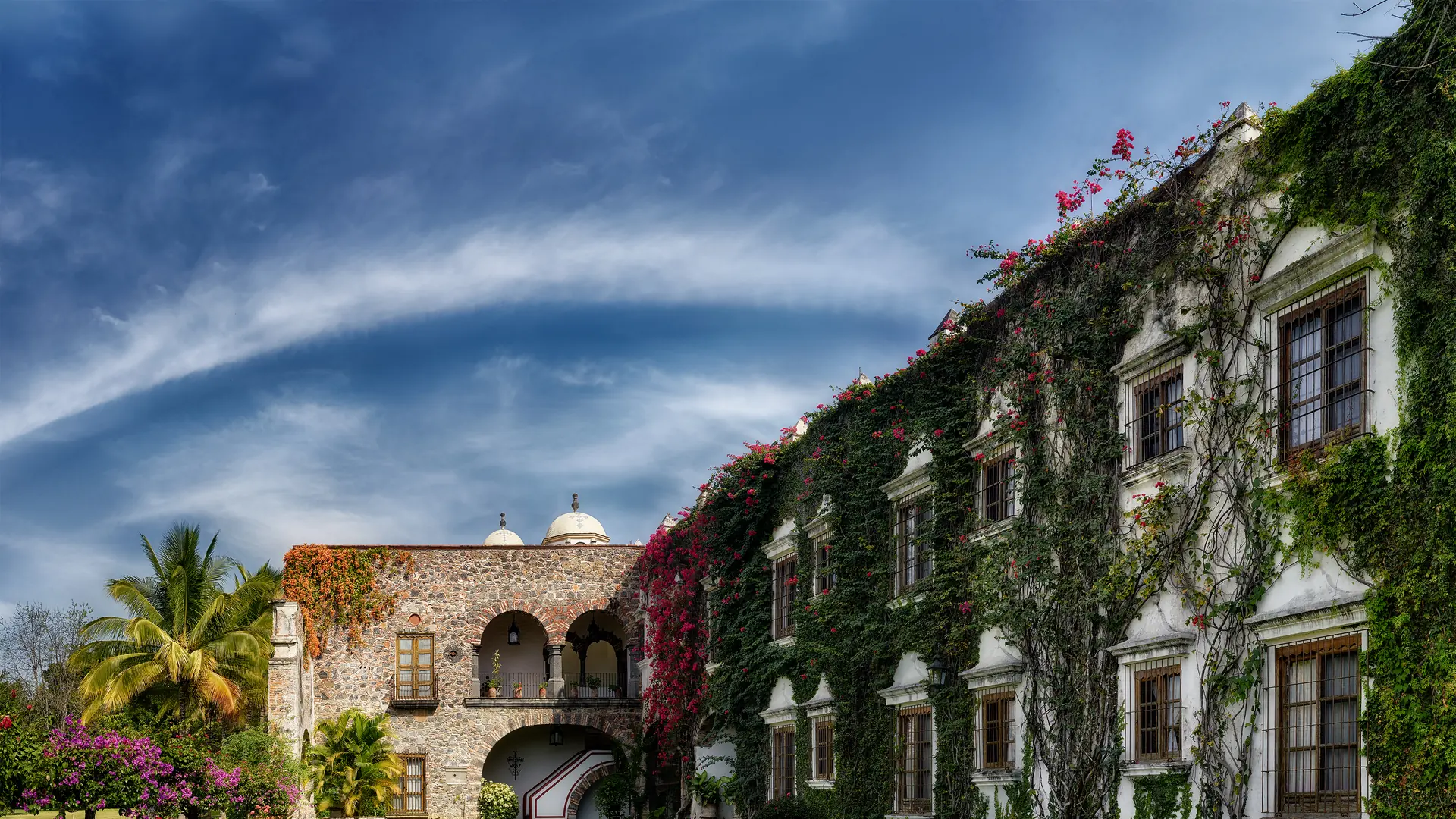
Hacienda Acamilpa, near Xochitepec. Founded in 1604, and the other Morelos property that shows up in international wedding coverage. The facade at the top of this page is Acamilpa.
Garden venues around Cuernavaca and Tepoztlán. A large share of Morelos weddings never happen at a famous hacienda at all. Same family-run logic, usually more so.
Lake Tequesquitengo, and being straight about the range. The lake has its own cluster of garden venues, several of them with water views, and they are a different proposition from the haciendas: more relaxed, and not aiming at the same level. I know that lake well, because it is where my family spends weekends. If that is the wedding you want, it is a real option. I would rather tell you the range honestly than pretend an entire state is one tier.
Tepoztlán: the Parroquia de la Natividad, and gardens outside town. The sixteenth-century Dominican ex-convent in the center is the town's main church and the default ceremony site. The pattern I have seen repeatedly is ceremony there, then reception at a garden on the edge of town. That is two locations and a short transfer, and the transfer is where timelines slip. Camera positions and flash are set by the parish and are not published anywhere; they get confirmed before the booking.
Facts for planners
One person, start to finish
I film a limited number of weddings a year, so the person you meet is the person who shows up and the person who edits.
No direction, no delays
I don't direct, pose, or recreate. Nothing is asked to happen twice, and the timeline doesn't lose a minute to video. I coordinate with the photographer rather than competing for position.
Built for family-run venues
I know these roads first-hand, so the drive times I put in a timeline are real ones, including the bad ones. I work in Spanish, and here that matters more than usual: arrangements are made with owners directly, not through a wedding department. I don't arrive assuming a resort's rules.
How I work, and how travel works
On the day, my only job is to watch. The film is built afterward in the edit, carried by the real audio of the wedding, the vows, the speeches, the sound of the room, with music and pacing chosen for that specific day rather than pulled from a template.
I'm based in Cancún and travel from there. Travel and availability are settled in the conversation, before anything is booked.
If the wedding is happening in the capital itself rather than an hour south of it, that is Mexico City, and there is a page for it.
Questions couples ask
Have you filmed a wedding in Morelos?
Not yet, and I would rather say that plainly. I have been going to Morelos my whole life: my grandparents lived in Cuernavaca and my family keeps a weekend house at Tequesquitengo. I have been to weddings at Cocoyoc, Vista Hermosa, San Gaspar, Acamilpa, San Gabriel de las Palmas and Temixco, and I photographed a wedding in Tepoztlán myself. The couple in the film on this page married at a hacienda, which is the same genre of wedding Morelos gives you. What I have not done is film a wedding in this state, and no page of mine is going to imply otherwise.
How long does it really take to get from Mexico City to Cuernavaca?
From the south of the city it is a little under an hour, which is the drive I grew up making. From elsewhere in the city, plan on an hour and a quarter to two hours door to door, and considerably more on Friday afternoons and long weekends. Holy Week can turn it into three or four. I would rather give you the range than the best case, because guest transportation gets built on these numbers. Even at the high end, your Mexico City guests are driving instead of flying.
When is the best time of year for a wedding in Morelos?
The seasons behave like Mexico City's but warmer, and spring gets genuinely hot. The advantage over the capital is that Morelos does not get the valley haze. The thing nobody mentions is the zafra: the sugarcane harvest runs from late November through April or May, and the cane is burned at night through that whole window, which overlaps almost exactly with the season the region advertises as its best. It is concentrated in the eastern and southern cane zones around Cuautla, Zacatepec and Jojutla, and Tepoztlán is barely touched. It is manageable, and it is worth asking about for your specific venue and month rather than discovering it.
Why can't you tell me the outside vendor fee at a Morelos hacienda?
Because most of these are family-run properties rather than hotels, and they do not have a standardized fee to quote. There is no policy page to read and no form to submit, so terms get agreed directly with the owners, property by property. It cuts the other way too, and this is the part people misread: a family operation is not a modest one. Some of the most luxurious weddings in the region happen at exactly these haciendas, and the absence of a vendor manual says nothing about the level of the wedding.
Cuernavaca or Tepoztlán?
Different weddings. Cuernavaca and the towns around it are hacienda country, formal, and the closest thing to a Yucatán hacienda wedding without the heat and the humidity. Tepoztlán is smaller, more mystical than colonial, and not as luxury as San Miguel de Allende, which is the comparison people usually reach for. The usual pattern there is ceremony at the Parroquia de la Natividad and reception at a garden outside town.
Can you fly a drone at a wedding in Morelos?
It depends entirely on the property, and I plan as though the answer is no until a venue clears it. Drones are regulated nationally by AFAC, with registration required between 250 grams and 2 kilos, visual line of sight, and a five nautical mile buffer from aerodromes. On top of that, each hacienda sets its own rule and none of them publish it, so it gets confirmed before the booking. Several of these properties are sixteenth-century and may fall under heritage restrictions as well.
Planning a Wedding in Morelos?
Documentary wedding films for haciendas, gardens, and historic venues in Cuernavaca, Tepoztlán, and across Morelos. Starting at $7,000 USD. Custom collections are built around coverage, story depth, and creative scope.
Want to understand how the investment is structured before reaching out? Full details here. → Wedding film investment and coverage options for destination weddings in Cancún and the Riviera Maya. Starting at $7,000 USD.