
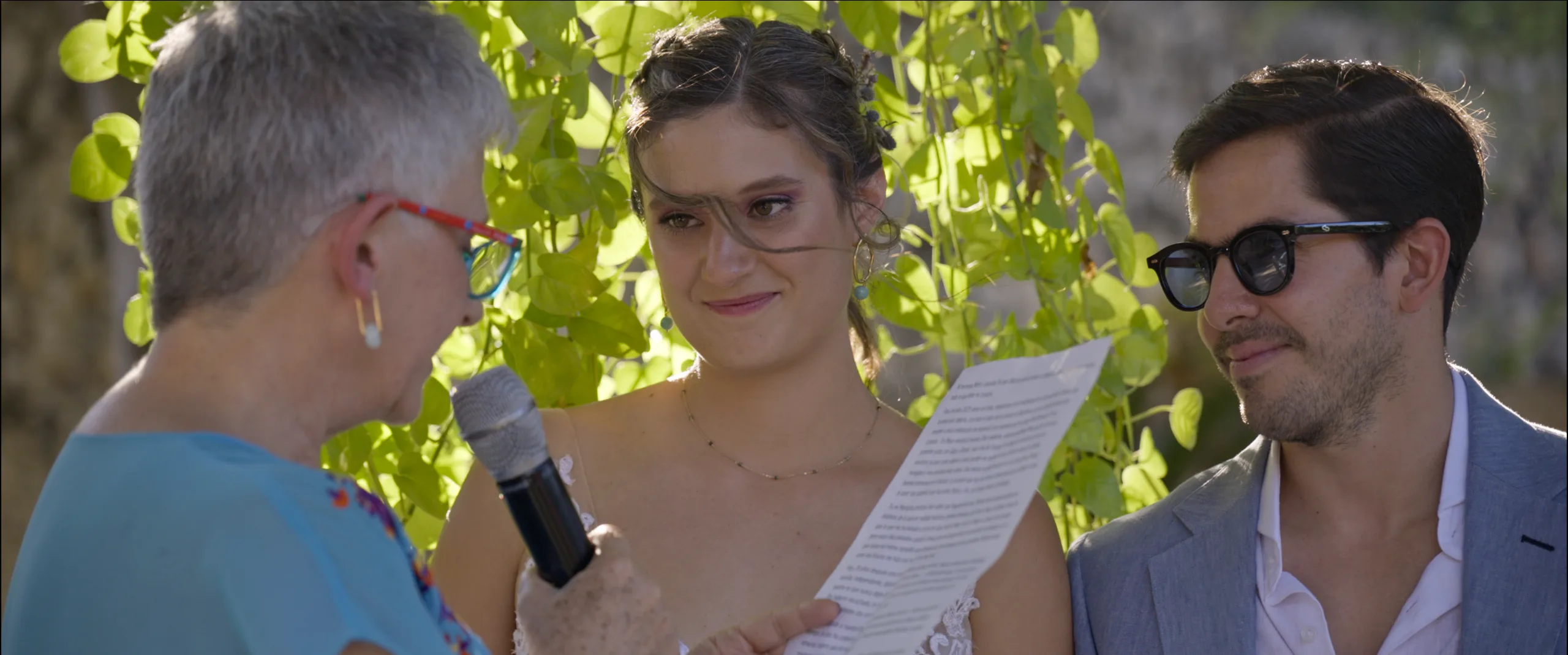
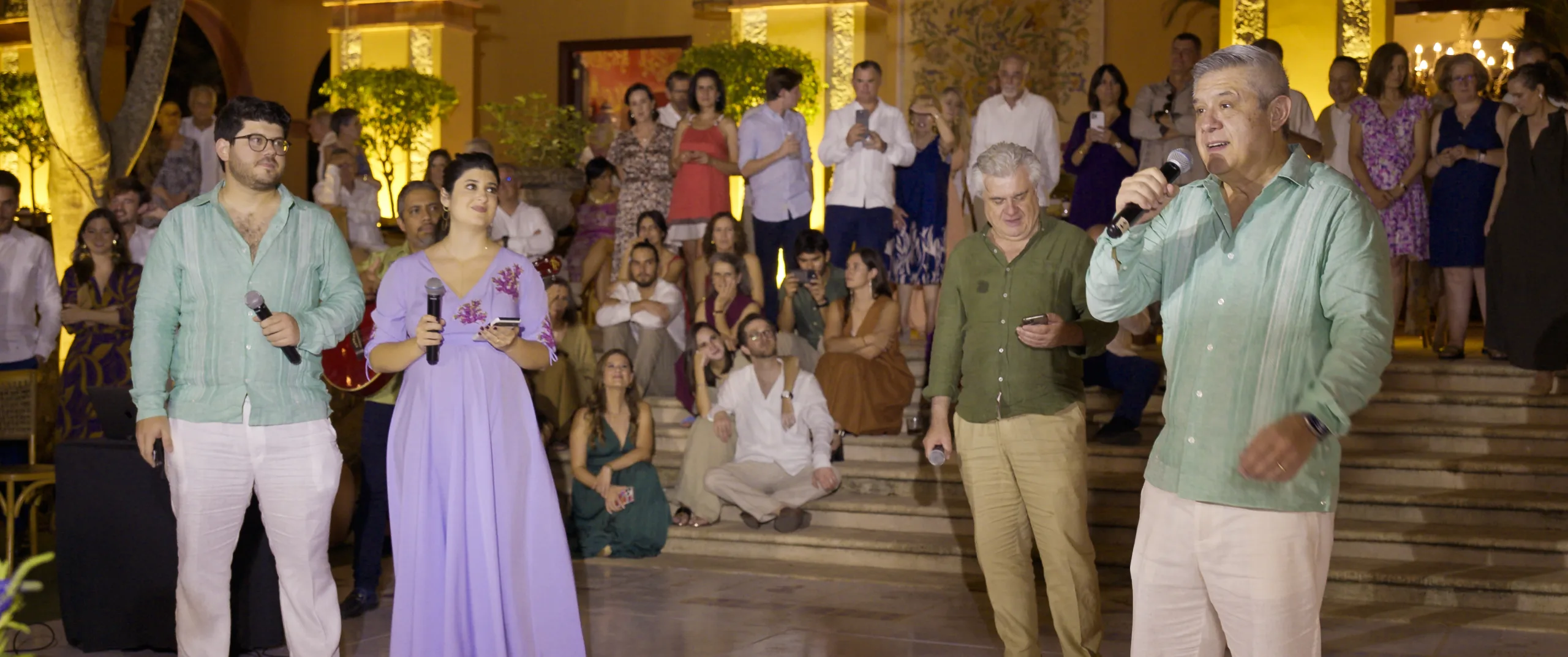
Picture two versions of the same wedding film. In the first one, your father's toast plays under a licensed song. You can see him talking, gesturing, holding the microphone, while a track someone chose from a music library fills the room. In the second one, the music drops away and you hear him: the pause before he starts, the joke that made the whole room laugh, the exact moment his voice breaks in the middle of a sentence he had practiced all week.
The first version is a video of your wedding. The second one takes you back there. The difference between them is not the camera. It is the audio.
Emotional memory lives in sound
Couples researching wedding video tend to compare what they can see: color, camera movement, drone shots, the look of the footage. It makes sense, because that is what portfolios show. But ask anyone what undoes them when they rewatch their wedding film years later, and the answer is almost never a shot. It is a voice.
The voice of a grandparent who is no longer here. The vows, said with shaking hands, in the exact words that were chosen for that moment. The sound of a specific room full of your specific people laughing at the same time. Images show you what the day looked like. Sound returns you to what it felt like to stand inside it.
This is also why audio is the least forgiving part of wedding filmmaking. A missed shot can be covered from another angle. A missed vow does not exist anywhere. There is no second take of your father's toast. Whatever was not recorded that day is gone in a way that nothing else in the production is gone.
The anatomy of audio in a wedding film
A wedding produces several distinct layers of sound, and a filmmaker who takes audio seriously plans for each one separately.
The vows and the ceremony are the spine. They are typically captured with dedicated microphones placed on the couple or the officiant, feeding into recorders that run independently of the camera. The redundancy is the point: if one recorder fails, clips, or catches wind, the backup exists. Professionals record audio in duplicate precisely because this is the one layer of the day that cannot be recovered.
The speeches and toasts are the second layer, usually captured from the venue's sound system and backed up with independent recorders. A speech that exists only as distant room echo from a camera microphone is, for practical purposes, lost.
And then there is the ambient layer, the one almost nobody thinks about until they hear it done well: the room tone of the getting ready suite, the crowd noise as the ceremony ends, the roar of the dance floor when the right song hits. This layer is what makes a film feel inhabited instead of scored.
Audio is not decoration. It is the structure of the edit.
Here is where audio stops being a technical topic and becomes a storytelling one. In a film built with care, the real audio of the day is not an extra track layered under pretty shots. It is the narrative spine the entire edit hangs on.
The vows can carry a film. When the words a couple actually said to each other run through the edit, every image they play over gains weight. The getting ready footage, the walk down the aisle, the quiet look during dinner: all of it means more because the voices are telling you what it meant. Music still matters, but its job changes. It accompanies what the voices are already saying instead of replacing them.
The alternative approach, and it is the dominant one, treats audio as a problem to be solved with a soundtrack. The result is the montage: attractive footage, licensed music, and a wedding that could belong to almost anyone. This is a big part of the difference between a highlight reel and an actual film, a distinction we unpack in documentary wedding films vs cinematic wedding films.
There is a simple test. Watch any wedding film and mute it for thirty seconds, then unmute. If nothing changed in your understanding of the story, the audio was decoration. If you lost the thread of the film, the audio was the structure.
What to ask a videographer about audio before you book
Audio quality is invisible in an Instagram reel, which is exactly why you have to ask about it directly. Four questions do most of the work.
Ask how they record the vows. The answer you want involves dedicated microphones and independent recorders, not "the camera picks it up." If the vows matter to you, they should not live on a single point of failure.
Ask whether the speeches are captured in full, even the parts that will not appear in the film. A filmmaker who records everything can later deliver a complete speech edit if you want one. A filmmaker who only recorded fragments cannot, and no amount of goodwill fixes that after the fact. Full ceremony and full speech edits are the kind of deliverable worth confirming in writing, along with everything else covered in what every couple should know before signing a wedding videography contract.
Ask what carries their films: the music or the voices. Then verify the answer by watching a full film, not a reel. Reels are cut to music by design. A complete film reveals what the filmmaker actually builds with.
And ask what happens if a recorder fails. The answer tells you whether they have thought about redundancy at all. Nobody plans to lose the vows. The ones who never lose them are the ones who planned anyway.
Closing thoughts
Cameras keep improving, and the visual gap between videographers keeps narrowing. What has not narrowed is the gap in how seriously people take sound. It remains the most underrated part of a wedding film, probably because it cannot be seen in a portfolio thumbnail.
But the couples who have lived with their films for a few years know. The footage shows you the day. The voices give it back to you. When you choose the person who will make your film, choose someone who treats the sound of your wedding as what it actually is: the only part of the day that can never be filmed again.
Frequently Asked Questions
Do wedding videographers record the vows?
The serious ones do, with dedicated microphones on the couple or officiant and independent backup recorders. But practices vary widely, and some videographers rely on the camera's built-in microphone, which produces distant, unusable audio. Always ask specifically how the vows will be recorded and whether there is a backup. This is the one part of the day that cannot be captured twice.
Why does audio matter in a wedding video?
Because emotional memory lives in sound. Years after the wedding, what brings the day back is not a drone shot, it is the voices: the vows as they were actually spoken, a parent's toast, the sound of the room. A film built on the real audio of the day feels like a memory. A film built on licensed music alone feels like a montage that could belong to anyone.
What audio should a wedding film include?
At minimum: the vows, the full ceremony, and the speeches, captured with dedicated equipment and backups. Beyond that, the ambient layer matters more than couples expect: the room before the ceremony, the crowd reaction, the energy of the dance floor. These sounds are what make a film feel like the actual day instead of footage set to music.
How do videographers capture speeches at weddings?
Typically by taking a feed from the venue's sound system and running independent recorders as backup. A speech captured only through a camera microphone from across the room is effectively lost. It is also worth asking whether speeches are recorded in full, even the parts that will not appear in the final film, so a complete speech edit remains possible if you want it later.