
Destination wedding marketing in Mexico tends to picture one wedding: a beach, an arch, a sunset ceremony of about thirty minutes. The reality of what gets celebrated here is far wider. Multi-day Indian weddings, Jewish ceremonies under a chuppah, full Catholic masses, symbolic ceremonies rooted in Mayan tradition, and same-sex weddings from couples in countries where the celebration they want is harder to have.
Each of these asks something structurally different from a venue, and this is where couples get burned: a property can be spectacular and still be structurally wrong for your celebration. This guide covers what each type of wedding actually needs, so you can ask the right questions before falling in love with the photos.
Jewish weddings
The visible centerpiece is the chuppah, and almost any venue can stand one on a beach or a lawn. The real venue questions live elsewhere.
Kosher catering is the structural one. If your wedding requires it, the conversation with the venue changes completely: does the property allow outside kosher caterers, does it have any experience hosting supervised kosher preparation, and what does that mean for the all-inclusive model where food is the core of the package. At resorts, this can be the difference between a workable plan and a dealbreaker, and it is exactly the kind of question to resolve in writing before signing. Private venues, where your planner controls the catering entirely, are structurally simpler for this.
Timing is the second: Shabbat-observant families shape the weekend around it, which affects which days and hours work for the ceremony and events around it. A venue used to one-size Saturday weddings may or may not flex.
And if your celebration ends with the hora, it is worth asking a more physical question than couples expect: how much clear, solid floor space does the reception area actually have. A dance that lifts chairs into the air has opinions about flooring and space that a standard beach reception layout does not anticipate.
Indian weddings
An Indian wedding in Mexico is less a wedding than a festival: typically three or more days of distinct events, from mehndi and sangeet to the ceremony and reception, each with its own setup, its own energy, and often its own dress code and decor.
That structure translates into venue requirements that eliminate most properties immediately. You need multiple event spaces, because the sangeet and the ceremony cannot share the same footprint on back-to-back days without brutal turnaround logistics. You need real guest volume across several nights, which favors either large resorts with room blocks or full-property buyouts. If the baraat, the groom's procession, is part of the plan, you need a route: somewhere for a procession with music and movement to actually happen, and a venue that permits it. And you need catering that can execute Indian cuisine at scale for several consecutive days, whether in-house or brought in, which again becomes a contract question at all-inclusive properties.
The practical filter: ask any venue you are considering how many multi-day Indian weddings it has actually hosted, and ask to speak with the planner who ran the most recent one. Experience with the format is not decorative here. It is the difference between a team that knows what Wednesday through Sunday looks like and a team discovering it on your dates.
Catholic weddings
Mexico is a deeply Catholic country, which cuts both ways for destination couples. Churches are everywhere, including some of the most beautiful colonial temples in the Americas, and the religious infrastructure is real. But a full Catholic sacramental wedding generally happens in a consecrated church, not on a beach, and that requires paperwork, coordination with the parish, and time. Requirements vary by diocese and parish, so this is a conversation your planner starts early, not a detail resolved the month before.
Many couples solve this in two parts: the sacramental ceremony in a church, and the celebration at the venue. If that is your structure, the venue question becomes about proximity and logistics between the two locations, and the timeline question becomes about light: church schedules and reception timing do not automatically respect the golden hour, and it is worth planning them together rather than separately.
Symbolic and Mayan ceremonies
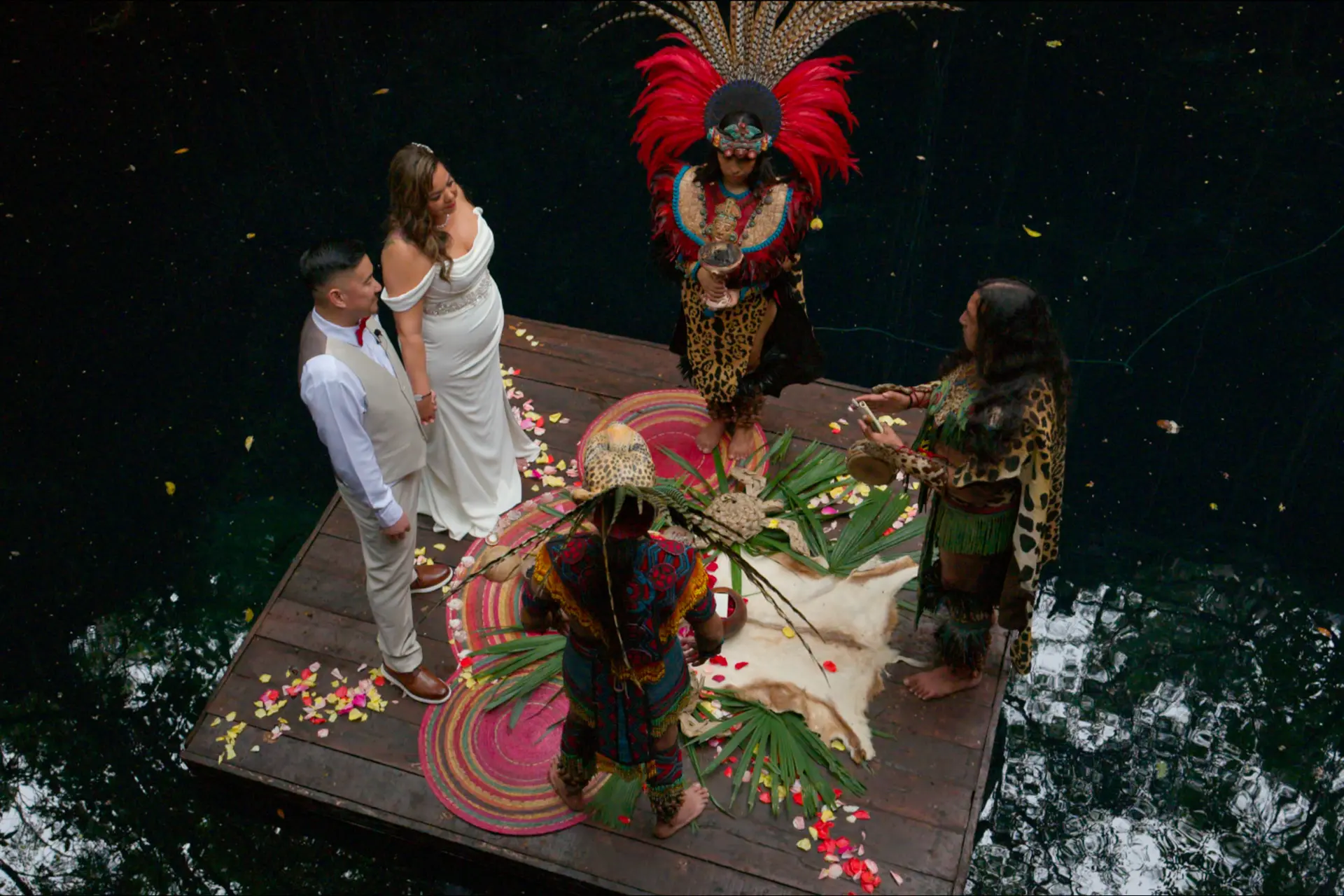
Because civil legal requirements in Mexico involve their own paperwork, a large share of destination weddings here are symbolic: legally married at home, celebrated in Mexico. That opens creative freedom that religious formats do not have, and one of its most distinctive expressions in this region is the Mayan ceremony, led by a shaman, built around the elements, often held at a cenote.
I filmed a different kind of symbolic ceremony at a hacienda in Yucatán, where family members spoke in place of a religious rite: the full account of that wedding is here.
Having filmed a cenote ceremony, I can say the venue considerations are real and specific: access logistics for guests and equipment, acoustics that behave nothing like open air, restrictions on where people can stand and what can be brought in, and light that transforms dramatically within a single hour. A cenote wedding rewards teams who have worked one before, on every side of the operation.
The honest note about Mayan ceremonies: there is a spectrum between ceremonies rooted in living tradition and performances staged for tourism. If authenticity matters to you, ask who leads the ceremony, where they come from, and what the ceremony includes, and let the answers guide you rather than the brochure.
LGBTQ+ weddings
Start with the fact many couples abroad do not know: same-sex marriage is legal in all of Mexico, in every state, and has been nationwide since 2022. Couples can legally marry here, not just celebrate symbolically.
The venue question is therefore not legal but cultural: not every property's wedding operation is equally experienced or equally warm, and the difference shows up in small operational moments, from how forms are worded to how a coordinator speaks about the couple. The useful filter is direct: ask the venue how many same-sex weddings it has hosted recently, and pay attention not just to the number but to how comfortably the question is received. Tourist destinations like Puerto Vallarta, Cancún, and Mexico City have deep experience; the point of asking is to find out whether your specific venue does.
The pattern across all of them
Read back through every section and the same structure repeats: each celebration has one or two structural requirements that most venues cannot fake. Kosher catering. Multi-day multi-space logistics. A consecrated church nearby. Cenote access. Genuine operational experience. The venue photos tell you none of this. The questions do.
This connects directly to how venues in Mexico actually work: all-inclusive resorts, luxury boutique properties, and private venues each handle special requirements completely differently, and knowing which model you are talking to changes what is even negotiable. We covered that structure in the three types of wedding venues in Mexico, and choosing a planner with real experience in your specific type of celebration is covered in how to choose a wedding planner for a destination wedding in Mexico.
Closing thoughts
Mexico can host virtually any celebration a couple can imagine, and does, every weekend of high season. What it cannot do is make every venue right for every celebration. The couples whose multi-day, multi-tradition, or non-traditional weddings go beautifully are not the ones who found a magical property. They are the ones who knew what their celebration structurally required, asked for it in writing, and built the team around it.
Whatever your tradition, that is the work worth doing before the deposit, not after.
Frequently Asked Questions
Can same-sex couples legally marry in Mexico?
Yes. Same-sex marriage is legal in all of Mexico and has been nationwide since 2022, in every state. Foreign couples can legally marry in Mexico, not only hold symbolic ceremonies, subject to the same civil paperwork requirements that apply to any foreign couple marrying in the country.
Can you have a Jewish wedding with kosher catering at a resort in Mexico?
It depends entirely on the property. Some resorts have experience with kosher requirements and allow outside kosher caterers; at others, the all-inclusive food model makes it complicated or impossible. This must be resolved in writing before signing the venue contract. Private venues, where the planner controls catering completely, are often structurally simpler for kosher weddings.
Which venues in Mexico can host a multi-day Indian wedding?
Ones with multiple distinct event spaces, guest capacity across several nights, catering that can execute Indian cuisine at scale for consecutive days, and ideally direct experience with the format. Large resorts with room blocks and full-property buyouts are the typical fits. Ask any candidate venue how many multi-day Indian weddings it has hosted and request to speak with the planner who ran the most recent one.
Can you have a Catholic wedding on the beach in Mexico?
Generally not as a full sacrament. Catholic sacramental weddings normally take place in a consecrated church, which Mexico has in abundance, and requirements vary by parish and diocese. Many couples hold the religious ceremony in a church and the celebration at their venue, which makes proximity between the two locations a real planning factor.
What is a Mayan wedding ceremony?
A symbolic ceremony led by a shaman, rooted in Mayan tradition and built around natural elements, often held at cenotes or outdoor sites in the Yucatán Peninsula. Quality varies from ceremonies rooted in living tradition to staged tourist versions, so couples who care about authenticity should ask who leads the ceremony and what it includes before booking.